Monday, 3 December 2012

Social Work in Uganda


Rachel Yutzy is a Social Work major completing her junior level social work practicum this semester on USP.

Over the last four months, I have been doing my social work practicum at a Compassion International site, Seeta Child Development Center. I can honestly say that my practicum was my favorite part of my experience in Uganda; I learned a lot about social work, Uganda, and myself.

I could have never imagined the learning experience I would gain from doing my internship abroad. Social Work is a very “Western” career. In the States, we have strict protocol as to how to do everything. We have a lot of theory and a lot of ideals. On a clinical level, we are very individualistic. We focus on the client at hand and attempt to know every detail of his or her life. One of the greatest challenges and best experiences was taking my American, higher education, book knowledge and theory, and applying to a situation on the other side of the world. Some things sound great on paper, but do not play out well due to the fact that the theory is tailored to a Western culture.

One prominent aspect of Ugandan culture is community. This aspect is a bit interesting in a social work setting. One of my first “counseling” sessions with a child was with about three extra adults in the room. According to the social workers, this is normal. This is what the community does. Everyone knows everything about everyone else and the value of the advice increases with the number of people reiterating it. From my context, this is not what you do. “Counseling” is done in privacy, or in a group of people struggling with the same thing, not in a community setting. However, as I was immersed in the culture, I began to realize just how much community affected the lives of the children with whom I was working. In a conversation with a co-worker, I learned that a lot of the children are orphaned or abandoned. The extended family or the community will take in the children. It is a community and a familial duty. He was appalled at the idea of a foster care system, where strangers take in children.
             
It was also interesting to see the similarities. Social work is still social work, no matter where you are on the globe. As my supervisor said, “Social Workers do everything. Everything is in the job description”. That could not have been said better. It seems as though social work agencies are always understaffed and underfunded; yet they still thrive and they still make a difference in their communities. I learned so much about the diversity and the flexibility of social work. I learned how it changes in culture. I learned how it functions on nothing. I saw dedication to hope, faith, and love in ways I have never seen before. I learned how the social work values, service, social justice, dignity and worth of a person, importance of human relationships, integrity, and competence can be universally applied, even when cultural norms are vastly different.


Post by Rachel Yutzy 

Friday, 23 November 2012

Thanksgiving in Uganda

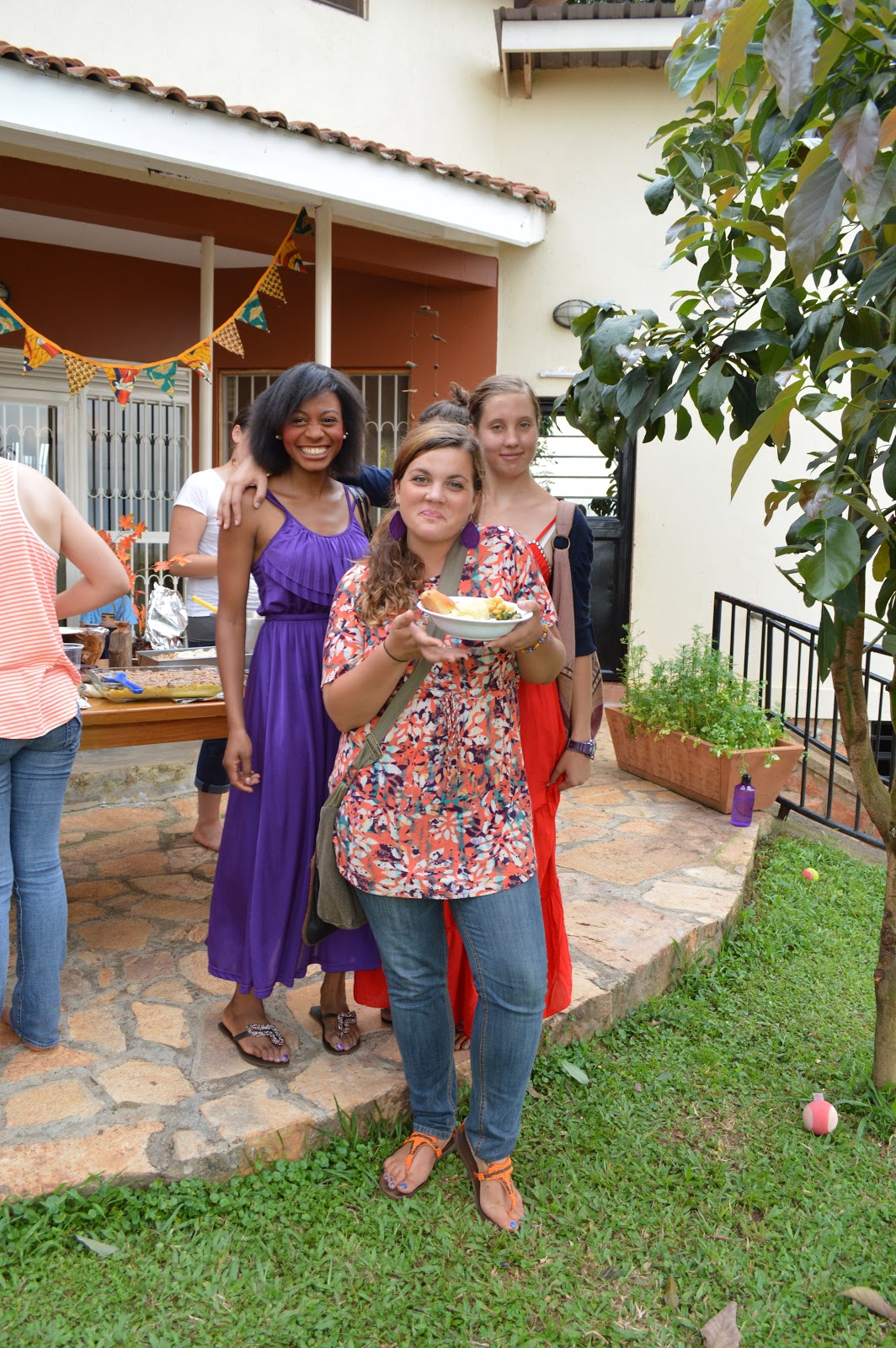
Celebrating Thanksgiving doesn't just have to be limited to being in America. Here in Mukono we celebrated Thanksgiving like we were back in the States. There was turkey (grilled not baked), stuffing, yams, green beans, mashed potatoes and all the desserts your heart could desire. The one thing we could not do was watch football in the morning. Yet we made up for that by playing football in the afternoon before dinner. Check out the pictures below of our Thanksgiving celebration!

Before the rumble in the jungle... or Mukono

Semi-action shot

The game is so intense that people are running in every direction

You wouldn't want Heather blocking you!

What is Thanksgiving without playing a little bit of corn hole?

Dinner time!


Wouldn't you be this happy if you were in a line for desserts?
(delicious desserts courtesy of the students)

post by program assistant Tiffany Gathers

Monday, 19 November 2012

Life in the Dorms.


You know what it’s like to live in a dorm: there’s music and dancing, there’s snack time and tea time, and of course, the reason we’re all here—studying! At UCU, life in the dorms is pretty typical. Students in the Uganda Studies Emphasis and Social Work Emphasis live on campus in the Honors College dorms, some room with UCU students, some in singles, and some with other USP students. So, while studying and sleeping have their place, there’s also time for impromptu movie watching, deep conversations, informal worship times, and even birthday parties and breakfast feasts.

A couple examples of the fun events: Earlier this semester USP students planned a surprise birthday party (birthday dance party no less, complete with cake) for their fellow classmate, Jean. Jean, a Ugandan Honors College student at UCU turned 22 and her friends, new and old, joined in the celebrations. As is typical in Uganda, she was doused with water (bath-day!), sung to, and given the honor of cutting and sharing the cake.  

October 9th is Uganda's independence day, and this year marked 50 years of independence. To help celebrate, USP students hosted a pancake breakfast for the Honours College students. It was an adventure cooking pancakes on a charcoal stove, but students were up for the challenge and the pancakes were delicious.

An important characteristic of Uganda’s communal culture is sharing and the dorms here are the perfect places for sharing to occur. This manifests itself in many ways, not only in sharing things like irons (for neat or 'smart' clothes), kettles and basins (for heating water, and washing), but students also share plenty of laughter, good stories, the celebration of life, and even cultural practices like pancakes for breakfast.


post by Program Assistant, Ruth Berta

Monday, 5 November 2012

Yoga!: A student's perspective on rural home stays by Becca Arnold

Hey everyone! So this past week, we headed up to Serere, Soroti, Uganda for a week of rural homestays! Going into this, I am not going to lie, I was a bit nervous. Where I live here, in Mukono, it is an unusual mix of urban and rural living. But growing up in the city, the idea of rural Uganda was a completely unknown world.

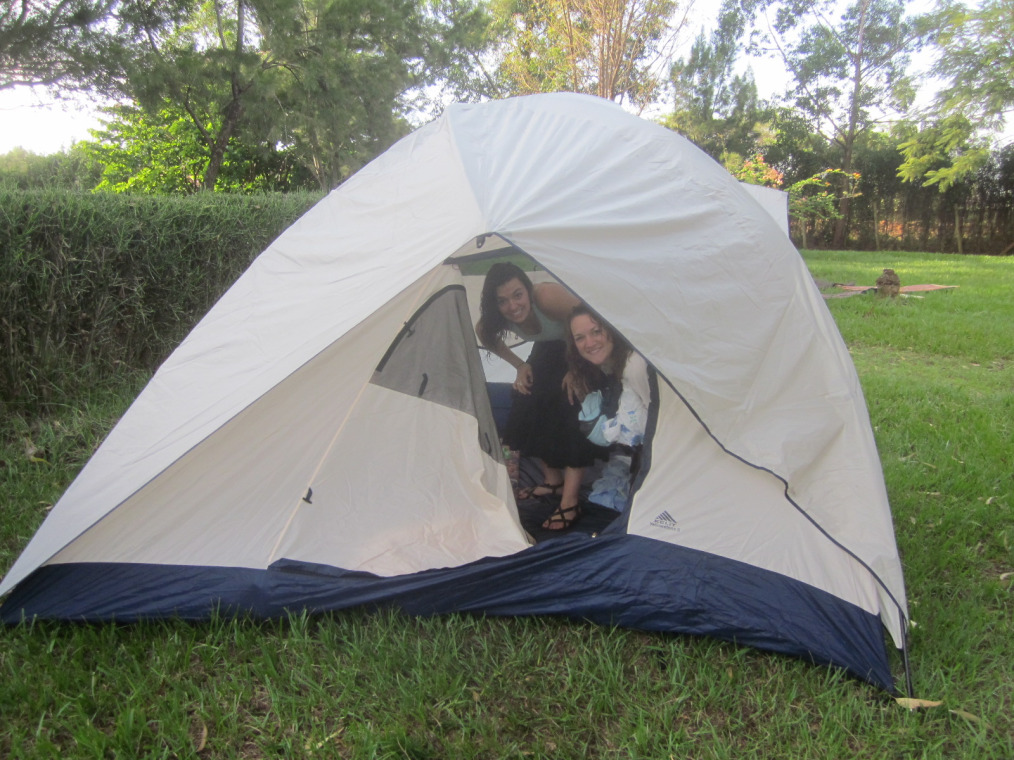
We left on Friday on a seven hour bus ride to the village. Friday night, we ended up spending the night at a guest house where myself and a few others chose to sleep in a tent for the night–the real camping experience haha, sort of.
Our beautiful home away from home... at least for the night

That night we ate together as a group and had a bonfire. It was a great way to end our time together for a week of separation. A few people and I stayed up a little later to watch the stars. It is so unfathomably beautiful out here with no light pollution. God is just so darn big and He knows each of these stars–pretty crazy! Eventually we went to bed in preparation for our big day the next day.
We woke up and found out that we were all being paired for our homestays with one other person. So I was paired with Emily. We drove for about 45 minutes and we were at our home for the week–quite isolated. But it was beautiful. Our family lived on a compound with about four huts and two buildings. They had 31 cows and 4 pigs and a ton of chickens and goats! 
One of the huts on our compound


Visiters enjoying oranges and tea with Emily and I

Our family consisted of our Toto (or Mama) and our Papa, our Toto’s sister, and then a nine year old little boy who was related in some way, Joseph. Then throughout the week, there were so many visitors in and out, it was hard to keep them all straight! The first couple of days our Toto’s daughter, Betty, came with her three children: Mercy, Emmanuel, and Faith. We had such a blast with all of the little kids! It was so sad when Betty had to leave with her kids on Wednesday :/ But we still enjoyed our time with Joseph–he was our buddy! Although he did not know any English, we became best friends. We had our own handshake and everything–so it was pretty official :) Also, the chief of the village’s daughter, Beatrice, came and hung out with us for the majority of our time there with her 9 month old son, Bryan. They spoke the language: Atesso. Yoga, in Atesso is how you would greet another person :)
We had the opportunity to do so many different things. Let me tell you, African women work so unbelievably hard, I cannot even explain how amazing they are!! They garden, clean, cook, and basically everything else. But our Papa was also a very hard working man and our host parents were some of the nicest people I have ever met. I feel so blessed that we were placed with this family and I was so sad to leave. I do not feel like I got to spend enough time with them all–but I hope, Lord willing, to go back someday and spend more time with them!!
We learned how to beat millet, grind cassava, grind g-nuts, and so many more things. I am going to miss them so very much but I am sure we will be able to stay in contact. Overall, my week was so amazing and I am just so thankful for all that I got to experience and I am thankful that I got to share the week with my friend, Emily! Then we went to Sipi Falls for a few days before going back to school where we had some awesome hikes to some beautiful waterfalls! It was a great way to end an amazing week!!
My family in Serere

Post by Becca Arnold 

Friday, 28 September 2012

ACHERU

Remember when you broke a bone when you were younger and as you were being casted you looked at the doctor in awe and wished that you could learn how to cast? No? That wasn’t an aspiration of yours? Well just imagine that it was an aspiration of yours, along with studying abroad in Uganda, and you discover that through USP you are able to do both through one of our very cool practicum sites! Okay, no more beating around the bush. Let me tell you a little story about an organization called ACHERU.


Afaayo (Luganda for “He cares”) Child Health and Rehabilitation Unit, or ACHERU, is a non-profit organization that does postoperative work on children with physical disabilities. The children stay at ACHERU during their rehabilitation (anywhere from several months to two years) with a parent/guardian and many receive additional reconstructive care.

USP students in the Cross Cultural Ministry Practicum class participate in a 40-hour practicum with various organizations in Mukono, including ACHERU. Those doing their practicum at ACHERU can do a number of different tasks on any given day including data processing and helping teachers with their lessons, all the while interacting with the children and their guardians at the site. This past Tuesday, one of our students had the opportunity to help the doctor cast a child!

Mike has never casted anyone before. This is what I love about ACHERU, if you are present and the doctor needs someone, he’ll call on you to help out. The girl’s leg had become deformed after malaria medication was wrongly injected into her nerves in her village. The casting would set her foot correctly.

I did my practicum at this site 6 years ago. One of the things I enjoyed then and continue to enjoy is the community atmosphere of ACHERU. Many of the staff live on-site with their families. It is fun to see and hear the staff member’s children playing in the background while the little girl was being casted. Rehabilitation is a very serious thing, but ACHERU is a friendly, open environment where people meet new people, learn how to do new things and genuinely enjoy one another. 


Summer playing with a staff member's son in the next room:

Mike, Heather and Summer with some of the patients and their guardians at ACHERU:


Post by Program Assistant, Tiffany Gathers

Friday, 21 September 2012

Visiting Mama Robinah and Shanae

Mama Robinah and Shanae (featured on the left)

As a Program Assistant one of my roles is to visit the IMME students (students living in semester-long homestays) at home, and this week I decided to visit Shanae. Shanae lives with Mrs. Robinah Lubanga Kiwanuka, who has been hosting students since 2004. Not only does she host USP students, Shanae informed me that Mama Robinah also hosts many other youth in her home through the year. I was intrigued to visit and learn more about this fascinating woman. 

The walk to Mama Robinah’s house took around 25 minutes; Shanae and I had to power walk to get there before 5:30 pm. We arrived hot and sweaty and not at all ready to drink the hot tea we imagined was coming. (Luckily Mama Robinah felt the same way!) Mama Robinah rose from her chair to greet me with a hug and asked me to sit. As Shanae, Mama Robinah and I sat at the table, the three of us started to fan ourselves. “I thought I was the only one who was hot,” Mama Robinah said as she was using her hand to cool herself down. Turns out it wasn’t just power walking to the house that made Shanae and I sweaty, it was also a hot day and Mama Robinah felt it too.

It was wonderful having tea at Mama Robinah’s house and to see how much Mama Robinah enjoys being with students. Since Shanae informed her host mother that I was coming over to visit, Mama Robinah made sure that tea was special that day, we had fresh orange/passion fruit juice was serviced along with samosas, fried pork and vegetables. (I know, right?!) The three of us sat at the table talking and laughing. Seeing Mama Robinah’s interaction with Shanae was a joy for me. Mama Robinah is extremely comfortable with America students and Shanae seemed relaxed and totally free to be herself. They both told me stories of how they worked in Mama Robinah’s garden together and Shanae’s experience of trying different Ugandan fruits. I left Mama Robinah’s house feeling as though I wanted to live at her house. Maybe it was the good food or the laughs that were shared, or the fact that Mama Robinah made me feel very welcomed and comfortable. Thanks Mama Robina and Shanae! Same time, same place next week? :) 


Post by Tiffany Gathers 

Wednesday, 19 September 2012

Fall 2012!

So sorry,we've been terribly lost... but we're back!

It is a new semester of USP and we are off and running with our group of 24. We're a month in, and so far, things are going well! Stay tuned for upcoming blog posts during this Fall 2012 semester. 

The group, good and dirty after participating in Umuganda, the community work day, while in Rwanda their first week on the ground.