Wednesday, 16 October 2013

Student Reflection


Sarah stayed with Ndamurani Family for her two week homestay and wrote the following essay about her experience.  Sarah's insightful reflection challenges Western superiority especially in terms of our use of the English language.

I have taken five years of Spanish, yet I can barely count to twenty; so saying that my dedication to learning another language is minimal would be quite the understatement. Coming from living in America all my life where I have taken for granted my ability to communicate with practically everyone, I am just now beginning to understand the value of knowing other languages. For some reason it is so easy for me to expect everyone else to speak my language and that be the end of any communication issue. I am learning through many African literature books that many people of the western world think this way and expect Africans to conform to their ways in all aspects of life including language. In Okot’s Song of Lawino the character Lawino shows how expected English is of an educated person by even referring to the dogs saying, “The dogs of white men are well trained and they understand English!” (p'Bitek, 115) These expectations are causing me to see how self-centered this mindset is. I am realizing that for the most part, although I should certainly not expect them to be, these self-centered expectations are met here in Uganda and should not be taken for granted.

            Knowing only one language myself, I never even considered that people knowing multiple languages might prefer one to another, especially the one they first learned. After several instances with the Ugandan family that I am staying with and from talking about languages in class, I continue to see over and over again how big this preference might be for most people.

When I arrived at the Ugandan household where I would be staying, it was a struggle to get much of a response from anyone. It was difficult to tell whether most of the family members did not speak English or if they were just hesitant in talking with me. It was clear that they were talkative people because of the multiple conversations constantly going on at once in Luganda.
            I quickly learned that if I wanted to have much interaction with anyone, the only way to do that was by repeating words they would say in Luganda. This was my entryway into becoming someone that would at least be acknowledged in conversation by the kids of the family—even if it was only because I was the comic relief. They enjoyed teaching me different phrases and hearing me attempt to pronounce the many words they would give me. This even led them to begin filling me in on what they were talking about in conversations unrelated to my learning Luganda.
After the excitement of me pronouncing words not much better than the 8 month-old baby in the house died down, they reverted back to their normal Luganda conversations that I cannot attempt to be involved in. Now that I felt like we were getting along I did not understand why they would not talk in English so that I could be apart of their conversations. Of course I expected them to speak Luganda when anyone was around that was not fluent in English, but it frustrated me when I knew everyone in the room could speak English well but they would still keep me out of the conversation by speaking Luganda. It was not until in class when we talked about people preferring to speak in their first language that I saw this side in a different light. This moment of realization was later confirmed when one of the boys told me how much he loved speaking in his local language.
In my short time staying with this Ugandan family I began to understand how much they enjoyed speaking Luganda but still did not fully grasp what my attempting to learn a few phrases meant to them. It was not until I learned from a classmate how to say, “can I help?” and “can you teach me how to cook?” in Luganda that I understood how right Craig Storti is when he says, “you don’t have to be fluent for people to appreciate the effort you’re making to talk to them.” (Storti, 103) I had asked many times if I could help do anything around the house in English and the reply was always for me to sit down. When I asked in Luganda, to my surprise, they allowed me to help. In one day I asked these questions to two different people and was successful with both after several days of no success in English. This is when it really became clear to me how important their own language is to this family and what my attempting to learn it meant. It was no coincidence that they were willing to show me how to help them and work with them only after I made the effort to ask in Luganda. It is as if asking in the language they love so much gave my request a whole new meaning.

P'Bitek, Okot. Song of Lawino ; &, Song of Ocol. London: Heinemann, 1984. Print.
Storti, Craig. The Art of Crossing Cultures. 2nd ed. Yarmouth, ME: Intercultural Press, 2001     

Friday, 11 October 2013

Two-week Mukono Homestays

From September 14th through the 27th the on-campus students went to stay with families in Mukono.  These families graciously welcome students into their homes, feeding them, teaching them how to participate in household chores, worshipping with them, teaching them some of the local language, etc.  Most students describe this experience as challenging, while also a very meaningful and memorable part of their semester abroad.  Here's what the students have to say...

Jonathan with his host mother, Mama Margaret
"While I initially experienced a lot of discomfort and culture shock in my home stay, I am proud to be part of a family here, and I still miss them, even though I am just down the street back on campus now!" - Jonathan

"My homestay was challenging, fantastic, and just an overall great learning experience.  Best way to learn is to live it."    -Kirstin

Jenna with the Butana family

Being called "mommy" by my nephews and having random people consider us family made me realize just how important family is here.  Also we had some really good food." -Tanya


Abby's homestay- The Kafeero Family

My homestay was a very challenging experience.  I learned that just like we stereotype Ugandans, they stereotype us as Americans, and dealing with some of these stereotypes was very challenging.  However, it was still a very good, growing experience." - Abby

"I learned so much from my host family- both culturally and because they're so different from my family back home!  I'm so grateful that I have the opportunity to connect with a Ugandan family while I'm here." - Mary Ann


Wednesday, 2 October 2013

A Full Weekend

On-campus students have returned from their two-week Mukono homestays (more details in a blog to come :) and in general all students are settling into the rhythm of the semester.  Classes are in full swing and students are busy with classwork, but we somehow manage to still have some fun on the weekends :)

This past Saturday, USP and Honors College students gathered on campus for SPORTS DAY.  We started early with a morning run...


In the afternoon we participated in a variety of activities.  We played soccer, volleyball, basketball and frisbee.  We also competed in an egg race and battled it out in tug-of-war.  


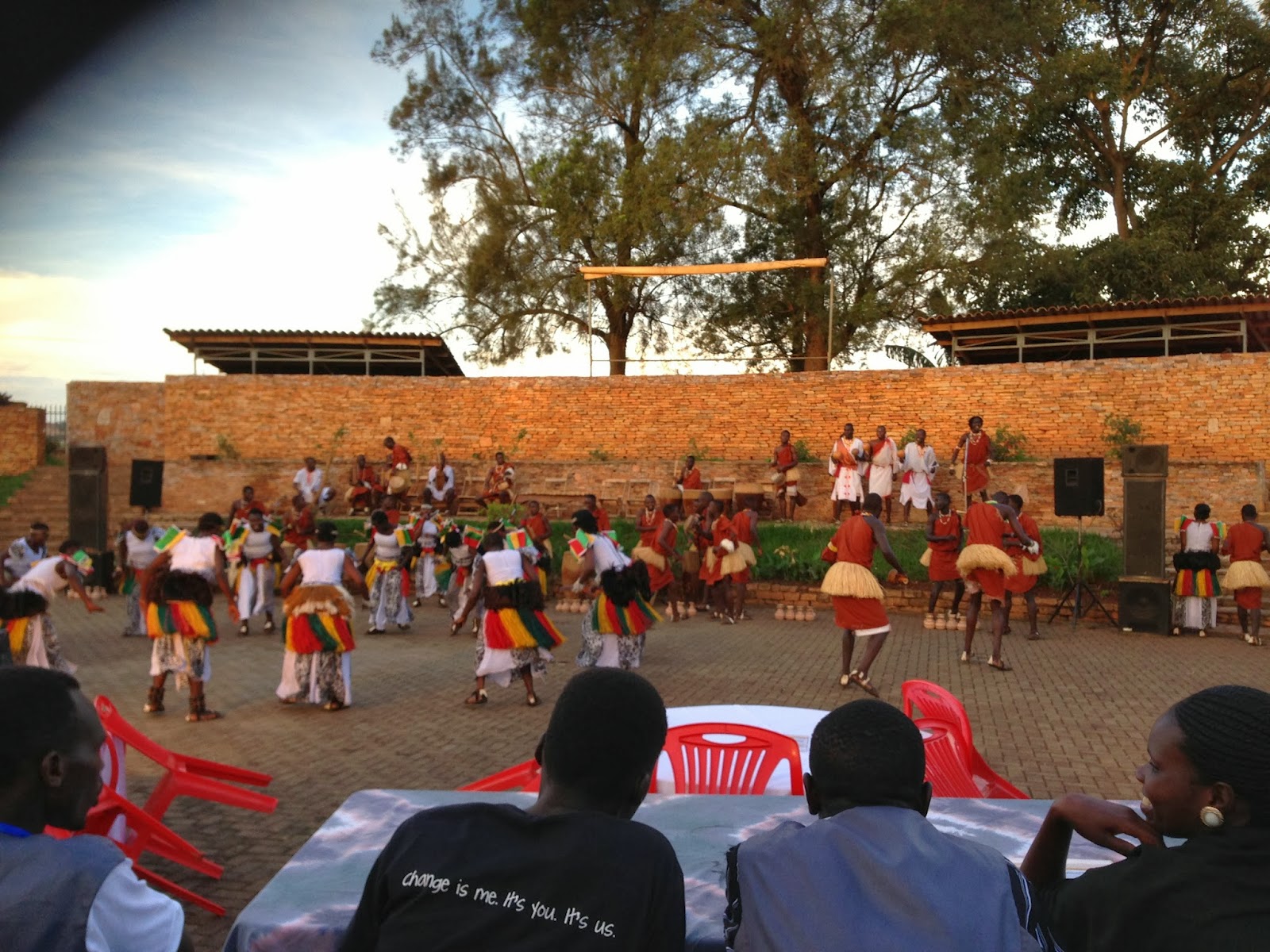
On Sunday evening we traveled to Ntinda to watch a performance by the Ndere Dance Troupe.  This show features dances and musical instruments from a variety of cultural groups all over Uganda. 


We even got to join in on the fun...
*Picture taken by Becca Stripe


Thursday, 26 September 2013

Welcome Party


Recently, the students in UCU's honors college threw a welcome party for the USP students. We played get-to-know-you games, ate a lot of fruit, danced together and prayed together. The USP students will be interacting closely with the honors college throughout the semester.  These students live with or near us and often become some of our closest friends on campus. 

Wednesday, 11 September 2013

RWANDA!

  3 vans...
    8 staff...
      10 days...
        27 students...
          33 blisters...
            40 packed lunches...
               
  800,000+ people
 remembered, 

1 country, 1 people moving on...


August 30th
We departed from UCU at 5:00am and journeyed to Rwanda. We spent some time at the equator, crossed the border into Rwanda and ended our journey at the Kibungo Guest House.


August 31st
This morning we participated in a country-wide community service mandate called Umuganda.  We worked with the Anglican Church in Kibungo transporting cement, rocks, dirt and tools so that professional builders could establish the foundation of a new office building. 

                                                                                                            September 1stWe attended three different worship services in rural Rwanda. We had the opportunity to lead the congregation in singing, give testimonies and even preach a sermon.  After eating lunch with the leaders of the churches we traveled to the capital city Kigali and settled into the Christuse Center--a Catholic Guest House where we stayed the next four days.                


September 2nd
We don't primarily travel to Rwanda to learn 
about the 1994 genocide, but we do see it as an 
important part of Rwanda's history and therefore 
devoted this day to visiting memorials and learning 
about this tragedy. We spent time in the Kigali
National Memorial and the Nyamatta Church.       


September 3rd
Today we visited CARSA--a Christian organization devoted to reconciling perpetrators and victims of the Rwandan genocide.  We split into groups and worked on community projects working alongside CARSA participants. 


September 4th
Since the horrors of the genocide, Rwanda has made swift progress in development as a country.  This morning we visited various micro-fincance organizations to learn about one form of development. In the afternoon we toured art galleries to experience a part of Rwandan culture.


September 5-7: Debrief 
We traveled to Bushara Island surrounded by Lake Bunyonyi, just across the border into Uganda.  It was a weekend to relax, reflect on our experiences in Rwanda and enjoy time together.  


Thoughts from students:
- "Awesome! Great balance of fun, work, learning...definitely unforgettable." -Kirstin Woodman

- "I feel so blessed to have experienced the beauty of the Rwandan countryside and to have had a glance into the pain and reconciliation occurring in such a beautiful country." - Elyce Hornor

- "If you want to live healthily in this world, you have to come to terms with the fact that evil exists and bad things happen, but still continue trying to change the world." - Antoinne (a genocide survivor who spoke to students)

- "My week in Rwanda was like going through a roller coaster of various emotions--hurt, anger, doubt, disbelief, hope, forgiveness." - Becca Stripe

- "Rwanda captured my heart more than I ever expected.  It was incredible to see the Kingdom of God being incarnated in the hillside villages and backroad churches of this tragic and hopeful country." -Mariel Rieland

- "The contrast between the joy of learning and the devastation of loss and depravity was unique, unexpected and unforgettable.    - Tim Elliot

- "I am not an idealist.  I am a kingdom realist.  The hope I want to point out is not out of this world, because the word became flesh and made his dwelling among us." - a quote from Mirror to the Church (the book students read during their time in Rwanda)


Throughout this experience we memorized the prayer of St. Francis.   
It has become our prayer as well. 

Lord, make me an instrument of Thy Peace.
Where there is hatred, let me sow love; 
where there is injury, pardon;
where there is doubt, faith;
where there is despair, hope; 
where there is sadness, joy;
where there is darkness, light.

O Divine Master, grant that I may not so much
 seek to be consoled as to console;
to be understood, as to understand;
to be loved, as to love. 
For it is in giving that we receive, 
it is in pardoning that we are pardoned,
It is in dying that we are born to eternal life. 


* Pictures taken by: Rachel Robinson & Becca Stripe


Thursday, 29 August 2013

Its just the beginning...

-

 The students have arrived! 

Here's what we have been up to the past few days:

- Orientation to Ugandan life

- Ultimate frisbee with students on campus

- Scavenger hunt in Mukono

-Dropping off students in semester-long homestays


Dana meeting and settling in with her host family


Tea Time!


...and now we are off to Rwanda!


Wednesday, 7 August 2013

We're Here!


Hello from the Fall 2013 Program Assistants! 
We are eagerly awaiting the arrival of our new students. Can't wait to meet you guys!